
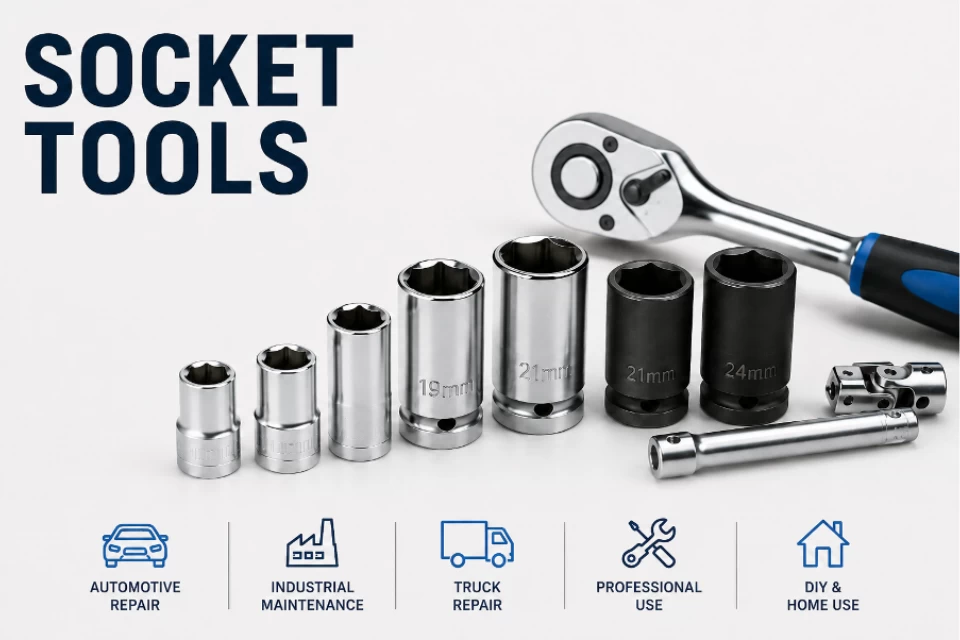
Socket tools are fastening tools used to tighten and loosen nuts, bolts, and other fasteners. They are commonly used with a ratchet handle, extension bars, adapters, impact wrenches, and related accessories to make repair, assembly, and maintenance work more efficient.
For professional users, socket tools are not just basic hardware tools. The right socket can improve fastening efficiency, provide a better fit with the fastener, support different torque requirements, and reduce problems during repeated use. This is why socket tools are widely used in automotive repair, motorcycle maintenance, bicycle servicing, truck repair, industrial assembly, equipment maintenance, and home DIY applications.
For tool brands, importers, and distributors, choosing the right hand tools supplier or hand tool manufacturer is also important. Buyers need products that are consistent in quality, suitable for different market needs, and available with flexible OEM/ODM support. As a Taiwan-based socket tool manufacturer, JIEYI HARDWARE provides hand socket, impact sockets, nut driver socket, socket set, and customized socket tool solutions for professional and industrial markets.
Socket tools are a group of fastening tools built around interchangeable sockets. A socket is usually a cylindrical tool head designed to fit over a nut, bolt, or fastener. Once connected to a ratchet handle, T-handle, extension bar, adapter, or impact wrench, the socket transfers torque from the driving tool to the fastener.
The main advantage of socket tools is flexibility. Instead of using many individual wrenches, users can change sockets and accessories according to fastener size, drive size, working depth, torque requirement, and working angle. This makes socket tools practical for repair shops, factory maintenance teams, assembly lines, professional toolkits, and general maintenance work.
A complete socket tool range may include hand sockets, impact sockets, nut driver sockets, socket sets, deep sockets, short sockets, stubby sockets, extension bars, adapters, universal joints, and other accessories. For B2B buyers, these products can be supplied as standard items or developed into custom hand tools based on market demand, brand positioning, and application needs.
At JIEYI, socket tools are viewed not only as individual products, but as part of a complete fastening solution for global tool brands, distributors, and professional users.
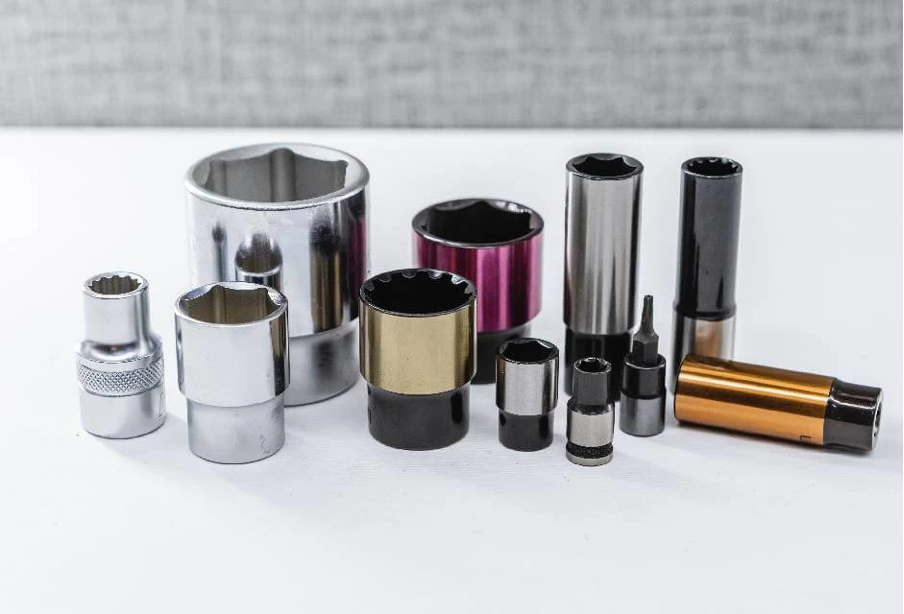
Socket tools come in different types depending on how they are used, the torque required, and the working environment. The most common types include hand sockets, impact sockets, nut driver sockets, socket sets, and socket accessories. Other options, such as deep socket, short socket, stubby socket, bit sockets, universal sockets, and spark plug sockets, may also be used for specific repair or assembly needs.
| Socket tool type | Main use | Common applications |
|---|---|---|
| Hand Socket | Manual fastening with ratchet handles or hand tools | Automotive repair, motorcycle maintenance, bicycle servicing, general repair |
| Impact Sockets | High-torque fastening with impact wrenches or pneumatic tools | Truck repair, automotive workshops, industrial maintenance, heavy-duty assembly |
| Nut Driver Socket | Light fastening where compact operation is needed | DIY projects, light assembly, furniture assembly, electrical-related fastening |
| Socket Set | Multiple socket sizes and accessories in one organized kit | Workshops, distributors, tool brands, professional maintenance teams |
| Film Processing | Excellent | Limited |
| Socket Accessories | Extending reach, changing drive sizes, or working at an angle | Machinery maintenance, vehicle repair, narrow or recessed working spaces |
For buyers, the best socket tool type depends on the target application, torque requirement, tool compatibility, and end-user market. Tool brands and distributors may also need customized socket combinations, packaging, surface treatments, or private label options to build product lines for different market segments.
JIEYI’s product categories include hand socket, hand tool accessories, hand socket sets, impact sockets, impact socket set products, impact accessories, and nut driver socket options. This gives buyers a practical foundation for both standard product sourcing and customized OEM development.
Socket tools are used wherever nuts, bolts, and fasteners need to be tightened, loosened, removed, or installed efficiently. They are commonly applied in repair, assembly, maintenance, and production environments.
Common applications include:
Because each application has different torque, size, and working-space requirements, buyers should select socket tools based on the actual use case. Automotive and industrial users may need both hand socket and impact sockets, while DIY or light assembly users may focus more on socket set products, nut driver socket tools, and compact accessories.
From JIEYI’s perspective, these applications show why professional hand tools need to be developed with both usability and durability in mind. A socket may look simple, but its size accuracy, material strength, surface treatment, and torque performance all affect how well it performs in real working conditions.
The main differences between socket tool types come from how they are used, how much torque they need to handle, and whether the fastener is easy to reach. For buyers, understanding these differences helps reduce product mismatch and choose the right tools for different end-user applications.
Hand socket tools are designed for manual use with ratchet handles, T-bars, and extension bars. They are suitable for controlled fastening tasks where the user applies torque by hand.
Impact sockets are designed for impact wrenches or pneumatic tools. They are built to handle higher torque, vibration, and repeated impact force, making them more suitable for automotive workshops, truck repair, industrial maintenance, and heavy-duty assembly.
Standard sockets are suitable for general fastening tasks where the fastener is easy to access.
A deep socket is longer and is used when the fastener is located on a long bolt or in a recessed area. Deep sockets are especially useful in automotive repair, machinery maintenance, and equipment servicing where standard sockets may not reach properly.
Individual sockets are useful when users need a specific size or replacement tool.
A socket set is better for workshops, maintenance teams, distributors, and tool brands that need a more complete product range. For B2B buyers, socket sets can also be planned by size range, application, packaging style, and target market. An OEM socket set may be developed for specific markets, such as automotive repair, industrial maintenance, professional workshops, or consumer toolkits.
For buyers developing their own socket tool product lines, these differences are not just technical details. They affect product selection, pricing strategy, packaging, end-user satisfaction, and long-term brand trust.
Choosing the right socket tool starts with understanding how and where the tool will be used. A socket used for bicycle repair will not have the same requirements as a socket used for truck maintenance, automotive repair, or industrial assembly.
Buyers should consider the application, fastener size, drive size, torque requirement, working space, tool compatibility, and product quality. For B2B buyers, customization options, packaging, and long-term supply capability are also important.
| Selection factor | What buyers should consider |
|---|---|
| Application | Automotive repair, truck maintenance, industrial assembly, DIY work, and bicycle servicing may require different socket types. |
| Torque requirement | Manual work may only need hand socket tools, while high-torque or powered applications require impact sockets. |
| Drive size | Smaller drive sizes are suitable for compact or light-duty work. Larger drive sizes are used for heavier fastening tasks. |
| Working space | Deep socket, short socket, stubby socket, extension bars, and universal joints may be needed for recessed, narrow, or difficult-to-reach areas. |
| Tool compatibility | Hand sockets should be used with manual tools. Impact sockets should be used with impact wrenches or pneumatic tools. |
| Quality and customization | Buyers should consider material strength, dimensional consistency, surface treatment, logo marking, packaging, and OEM/ODM support. |
For professional users, product quality is just as important as size. A reliable socket should fit the fastener properly, transfer torque smoothly, and withstand repeated use. Poorly made sockets may wear quickly, damage fastener corners, or fail under torque. These issues can lead to downtime, extra replacement costs, and safety concerns.
For tool brands, importers, distributors, and wholesale tool supplier partners, the right socket tool is not only the product that fits the fastener. It is also the product that fits the target market, user expectations, and brand positioning. This is where working with an experienced hand tool manufacturer can make product planning and sourcing much smoother.
For global tool brands and distributors, socket tools need more than correct dimensions. Buyers often look for a supplier that can provide stable production, consistent quality, flexible customization, and responsive technical communication.
JIEYI HARDWARE specializes in socket tools, hand tools, impact tools, and nut driver socket products for professional and industrial markets. As a hand tool manufacturer and hand tools supplier, JIEYI supports buyers who need standard socket tools, impact sockets, impact socket set products, OEM socket set development, and customized tool solutions.
For OEM buyers, JIEYI can manufacture socket tools based on customer-provided specifications, branding requirements, and packaging designs. For ODM buyers, JIEYI can support product development, technical design, prototype development, testing, and large-scale manufacturing. This is helpful for companies that want to launch new socket tool products or build a product line tailored to regional market needs.
For buyers searching for impact socket manufacturers or an impact socket supplier, JIEYI can support the development of impact sockets and related impact tool accessories for automotive, truck repair, and industrial maintenance applications. For brands building broader hardware tools or professional hand tools programs, JIEYI can also help plan socket combinations, set configurations, and packaging directions based on the target market.
Whether the need is for hand socket products, impact sockets, nut driver socket tools, socket set programs, or custom hand tools, JIEYI can serve as a manufacturing partner for long-term product development.
Socket tools are essential fastening tools used to tighten and loosen nuts, bolts, and other fasteners. They are widely used in automotive repair, motorcycle maintenance, bicycle servicing, truck repair, industrial assembly, equipment maintenance, and home DIY work.
The most common types include hand socket, impact sockets, nut driver socket, socket set products, and socket accessories. Each type is designed for different fastening conditions, torque requirements, working spaces, and tool compatibility needs.
For professional users, choosing the right socket tool improves work efficiency, fastening reliability, and safety. For tool brands, importers, distributors, and wholesale tool supplier partners, choosing the right socket tool manufacturer is just as important. A reliable supplier should provide stable quality, technical support, customization flexibility, and long-term production capability.
If you are looking for hand socket products, impact sockets, nut driver socket tools, socket set programs, OEM socket set development, or customized socket tool solutions, JIEYI HARDWARE can help you develop socket tools that fit your market, brand, and application needs.
Socket tools are used to tighten, loosen, remove, or install nuts, bolts, and other fasteners. They are commonly used in automotive repair, motorcycle maintenance, bicycle servicing, truck repair, industrial assembly, equipment maintenance, and home DIY applications.
The main types of socket tools include hand socket, impact sockets, nut driver socket, socket set products, and socket accessories. Depending on the application, buyers may also need deep socket, short socket, stubby socket, universal sockets, or spark plug sockets.
Hand socket tools are designed for manual use with ratchet handles, T-bars, and other hand tools. Impact sockets are designed for impact wrenches or pneumatic tools and can handle higher torque, vibration, and repeated impact force.
To choose the right socket tool, buyers should consider the application, fastener size, drive size, torque requirement, working space, and tool compatibility. For professional or industrial use, product quality, material strength, and long-term durability are also important.
Yes. Socket tools can be customized for OEM and private label brands, including socket size, surface treatment, logo marking, packaging, socket set combination, and product specifications. This is especially useful for tool brands, importers, distributors, and wholesale tool suppliers that need market-specific product lines.
JIEYI supports socket tool buyers with hand socket, impact sockets, nut driver socket, socket set products, and customized socket tool solutions. For OEM/ODM projects, JIEYI can assist with product development, specification planning, surface treatment, logo marking, packaging, testing, and mass production support.
Updated: 2026-06-06
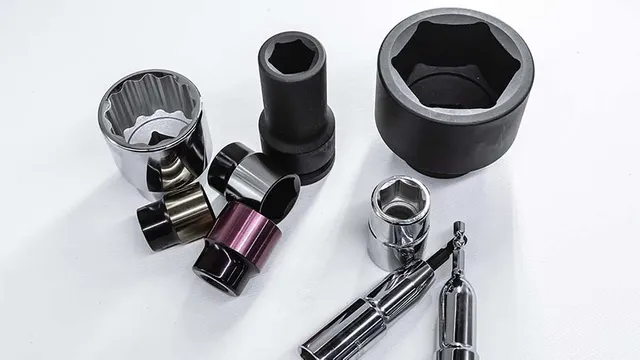
JIEYI HARDWARE is renowned for producing high-quality socket tools that comply with DIN and ANSI standards.