If you are looking for socket tools with your own specifications, branding, or packaging, choosing an existing catalog product may not always be enough. You may need a different socket length, wall thickness, drive size, surface finish, logo, set configuration, or even a socket developed for a specific application.
An experienced OEM socket manufacturer can help turn these requirements into a production-ready product. Depending on the project, customization may involve dimensions, materials, surface finishes, branding, packaging, sample development, and testing before mass production.
JIEYI is a Taiwan-based socket tool manufacturer providing OEM and ODM services for international tool brands, importers, distributors, and industrial buyers. Its product range includes hand sockets, impact sockets, socket sets, and related socket tools.
This guide explains how custom socket tools are developed, what buyers need to prepare, and how to decide whether an existing, modified, or fully custom socket is the right choice.
An OEM socket manufacturer produces socket tools according to a buyer's specifications, target application, or branding requirements. However, not every OEM project requires a completely new product.
For some buyers, an existing socket may already meet the required performance and dimensions. In this case, customization may focus on logo engraving, size markings, surface finish, set combinations, carrying cases, trays, or private-label packaging.
Other projects require changes to the socket itself, such as a different drive size, deeper design, thinner wall, special working profile, non-standard dimensions, or an impact socket developed for a particular application.
JIEYI supports both approaches. If an existing product is suitable, the project can focus on branding and packaging. If the application cannot be covered by a standard socket, JIEYI can evaluate whether a modified or fully custom design is needed.
For buyers, this means you do not need to finalize every technical detail before starting a discussion.
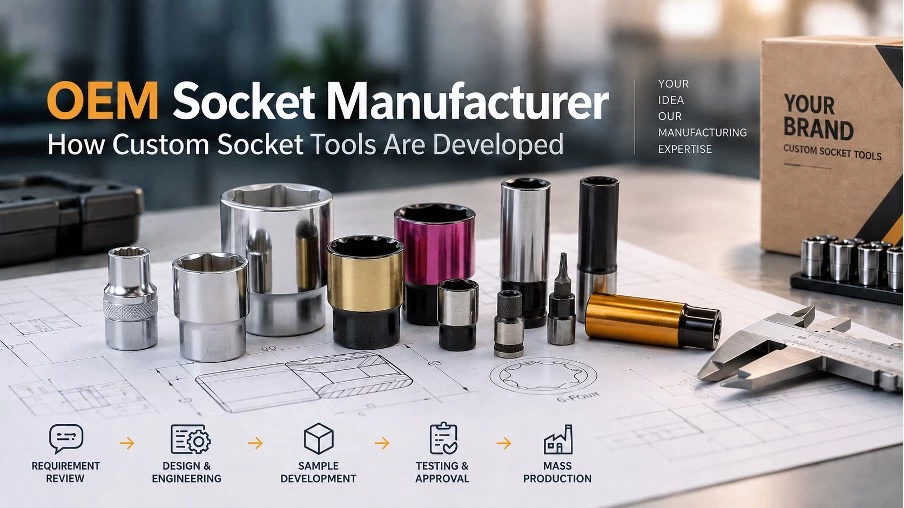
A typical OEM socket project can be divided into six main stages, from understanding the application to preparing the approved product for mass production.
When starting an OEM socket project, buyers do not need to decide the material or every technical specification first. A better starting point is to explain how and where the socket will be used, because the application affects the appropriate socket type, dimensions, material, and performance requirements.
For example, the socket may be intended for automotive repair, truck or motorcycle maintenance, industrial assembly, machinery maintenance, hand tool use, pneumatic or electric impact wrenches, heavy-duty fastening, or use in restricted working spaces.
Hand sockets and impact sockets are designed for different operating conditions. Understanding the application first helps the manufacturer recommend a more suitable direction instead of simply following a size specification.
You also do not need a complete drawing before contacting JIEYI. A custom socket project can begin with a physical sample, reference product, existing specification, required dimensions, technical drawing, product concept, or a clear description of the fastening application.
Once the application is clear, the next step is to define the product requirements. These may include the drive size, socket opening, overall length, wall thickness, working profile, surface finish, markings, or packaging.
| Item | Examples |
|---|---|
| Drive Size | 1/4", 3/8", 1/2", 3/4", 1" |
| Socket Size | Metric or SAE |
| Length | Standard, deep, or customized |
| Wall Design | Standard or thin-wall |
| Working Profile | 6-point, 12-point, or special profile |
| Socket Type | Hand socket or impact socket |
| Surface Finish | Based on application or branding needs |
| Marking | Size, logo, model number |
| Packaging | Individual, set, tray, case, or private label |
Not every change requires new tooling. If an existing socket already meets the technical requirements, changing the logo, finish, packaging, or socket combination may be enough.
If the product requires a different length, thinner wall, special profile, or other dimensional changes, JIEYI can evaluate whether an existing design can be modified. This can help avoid unnecessary development work and tooling costs.
Buyers often ask what material should be used for a custom socket, but there is no single answer for every project. The appropriate choice depends on the socket type, dimensions, application, and performance requirements.
For example, a socket used with an impact wrench operates under different conditions from a socket used with a hand ratchet. Instead of asking buyers to determine every technical detail in advance, JIEYI can review the intended use together with the required size, drive, dimensions, finish, and performance expectations.
The same applies to product design. A change that seems small, such as reducing wall thickness or increasing socket depth, may affect manufacturing feasibility or product performance. Reviewing these factors before tooling helps reduce the risk of having to redesign the product later.
If your project needs to meet specific DIN, ANSI, ISO, or customer requirements, these can also be discussed during the evaluation stage.
Before moving into mass production, a sample allows both the buyer and manufacturer to confirm the product.
Depending on the project, the buyer may check dimensions, fit with the intended fastener, drive compatibility, surface finish, logo and markings, overall appearance, functional performance, and packaging.
This is especially important for modified or fully custom products. A drawing may look correct, but a physical sample gives the buyer a better way to confirm whether the socket performs as expected in the real application.
If the requested product is close to an existing JIEYI socket, modifying a current design may also be possible. This can simplify the development process compared with creating a completely new product.
For an OEM buyer, the goal is not only to receive one correct sample. The manufacturer must also be able to reproduce the agreed product consistently during mass production.
Before production begins, the buyer and manufacturer should confirm what will be inspected. Depending on the product, this may include dimensions, hardness, torque or functional performance, fastener fit, surface condition, logo and marking accuracy, packaging, and appearance.
JIEYI operates under an ISO 9001:2015 quality management system and manufactures socket tools according to relevant product and customer requirements, including DIN and ANSI specifications where applicable.
Agreeing on the quality criteria before production helps make the approval and inspection process clearer for both sides.
For tool brands and distributors, OEM development often includes more than the socket itself. The final product may also require logo engraving, size markings, model numbers, surface treatment, plating, polishing, knurling, product trays, carrying cases, socket combinations, or private-label packaging.
For buyers developing a complete product line, JIEYI also offers hand socket sets and impact socket sets. This allows sockets, accessories, set combinations, and packaging to be planned together.
Once the sample, specifications, branding, and packaging are approved, the product can move into mass production.
JIEYI provides OEM and ODM socket manufacturing in Taiwan for overseas tool brands, importers, distributors, and industrial buyers.
Depending on the project, JIEYI can support custom socket dimensions, material selection, surface treatment, logo engraving, product markings, socket set configuration, private-label packaging, sample development, product testing, and mass production.
Its product range includes hand sockets, impact sockets, socket sets, impact accessories, extension bars, ratchet handles, nut driver sockets, and other related socket tools.
This gives buyers flexibility when developing either a single custom product or a broader socket tool range. Some buyers may already have a completed drawing and simply need a reliable manufacturing partner, while others may only have a sample, application requirement, or product concept that still needs further development.
Both can be used as a starting point.
You do not need a complete engineering package before contacting JIEYI. A drawing, physical sample, competitor or reference product, required dimensions, existing specification, branding requirement, or new product idea can all help start the discussion.
JIEYI can review the available information and help determine whether an existing product, modified socket, or fully custom socket is the most suitable approach for your project.
Providing clear information helps the manufacturer evaluate your project and prepare a more accurate quotation.
If available, it is useful to provide:
You do not need to have all of this information ready for the first inquiry. If you only have a physical sample, reference product, required size, or application requirement, send that first. The remaining specifications can be discussed during project evaluation.
There are generally three ways to approach an OEM socket project.
This is suitable when an existing socket already meets your technical requirements and you mainly need your own logo, markings, surface finish, set combination, or packaging.
For distributors and tool brands developing a private-label product range, this is often the simplest way to start.
A modified socket may be more suitable when a standard product is close to your requirements but needs changes to length, wall thickness, depth, profile, or other dimensions.
This approach can provide more flexibility without necessarily developing a completely new product.
A fully custom design may be necessary when the application requires special dimensions, unique geometry, restricted-space access, special fastener engagement, or other application-specific features.
If you are unsure which option is right for your project, an experienced custom socket manufacturer should help evaluate the most practical approach before tooling begins.
When comparing suppliers, price is important, but it should not be the only factor. For a long-term OEM program, buyers should also consider whether the manufacturer can support different levels of customization, work from a drawing or physical sample, maintain consistent quality, and coordinate branding and packaging.
A supplier with both OEM and ODM capabilities can provide more flexibility. This is useful when some products are already fully specified while others are still at the concept or development stage.
Quality control is another important consideration. Buyers should understand what will be inspected before mass production and how the agreed specifications will be maintained throughout production.
For private-label programs, it is also more convenient when product customization, branding, socket set configuration, and packaging can be managed through the same manufacturing partner.
Yes. JIEYI supports private-label socket projects including logo engraving, product markings, surface treatment, socket set configuration, and packaging.
Yes. A custom socket project can begin from a drawing, physical sample, existing specification, reference product, or application requirement. JIEYI can review the available information and discuss the appropriate development process.
Yes. Depending on the project, impact sockets may be customized in terms of drive size, socket size, length, profile, dimensions, surface treatment, markings, and set configuration.
Because impact sockets operate differently from hand sockets, it is important to tell the manufacturer how the socket will be used.
You do not need to finalize every technical detail before making an inquiry. Provide the intended application, required size, expected use, and any available drawing or sample. JIEYI can review the information and discuss suitable specifications with you.
Yes. For customized projects, sample development and approval can be used to confirm dimensions, fit, appearance, markings, surface finish, and other agreed requirements before mass production.
A successful OEM socket project starts with understanding what product you need and how it will be used. Whether you are looking for a private-label socket set, custom hand socket, OEM impact socket, special-size socket, or a socket developed for a specific application, JIEYI can support the project from requirement review and sample development through mass production.
You do not need to have every technical detail finalized before contacting JIEYI. A drawing, physical sample, existing product, specification, reference product, or clear application requirement can all be used as a starting point.
If you have a socket project in mind, send JIEYI your product requirements, intended application, required size or drive, estimated quantity, and any branding or packaging needs. Contact JIEYI to discuss your OEM/ODM socket project and find the right manufacturing solution for your market.
Updated: 2026-09-22
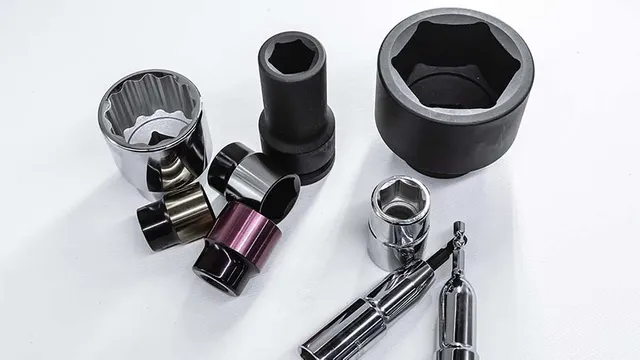
JIEYI HARDWARE is renowned for producing high-quality socket tools that comply with DIN and ANSI standards.